Mutual Fund
 
As you probably know, mutual funds have become extremely popular over the last 20 years. What was once just another obscure financial instrument is now a part of our daily lives. In fact, to many people, investing means buying mutual funds. After all, it's common knowledge that investing in mutual funds is (or at least should be) better than simply letting your cash waste away in a savings account.
A mutual fund is nothing more than a collection of stocks and/or bonds. You can make money from a mutual fund in three ways:
  • Income is earned from dividends on stocks and interest on bonds. A fund pays out nearly all income it receives over the year to fund owners in the form of a distribution.
  • If the fund sells securities that have increased in price, the fund has a capital Gain. Most funds also pass on these gains to investors in a distribution.
  • If fund holdings increase in price but are not sold by the fund manager, the fund's shares increase in price. You can then sell your mutual fund shares for a profit
  • Professional Management - A mutual fund is a relatively inexpensive way for a small investor to get a full-time manager to make and monitor investments.
  • Diversification - By owning shares in a mutual fund instead of owning individual stocks or bonds, your risk is spread out.
  • Economies of Scale - Because a mutual fund buys and sells large amounts of securities at a time, its transaction costs are lower than you as an individual would pay.
  • Liquidity - Just like an individual stock, a mutual fund allows you to request that your shares be converted into cash at any time.
  • Simplicity - Buying a mutual fund is easy! Most Companies have their own line of mutual funds, and the minimum investment is small.
 

There are a wide variety of Mutual Fund schemes that cater to your needs, whatever your age, financial position, risk tolerance and return expectation. Whether as the foundation of your investment program or as a supplement, Mutual Fund schemes can help you meet your financial goals. The different types of Mutual Funds are as follows:

Diversified Equity Mutual Fund Scheme
A mutual fund scheme that achieves the benefits of diversification by investing in the stocks of companies across a large number of sectors. As a result, it minimizes the risk of exposure to a single company or sector.

Sectoral Equity Mutual Fund Scheme
A mutual fund scheme which focuses on investments in the equity of companies across a limited number of sectors -- usually one to three.

Index Funds
These funds invest in the stocks of companies, which comprise major indices such as the BSE Sensex or the S&P CNX Nifty in the same weightage as the respective indice.

Equity Linked Tax Saving Schemes (ELSS)
Mutual Fund schemes investing predominantly in equity, and offering tax deduction to investors under section 80 C of the Income Tax Act. Currently rebate u/s 80C can be availed up to a maximum investment of Rs 1,00,000. A lock-in of 3 years is mandatory.

Monthly Income Plan Scheme
A mutual fund scheme which aims at providing regular income (not necessarily monthly, don't get misled by the name) to the unitholder, usually by way of dividend, with investments predominantly in debt securities (upto 95%) of corporates and the government, to ensure regularity of returns, and having a smaller component of equity investments (5% to 15%)to ensure higher return.

Income schemes
Debt oriented schemes investing in fixed income securities such as bonds, corporate debentures, Government securities and money market instruments.

Floating-Rate Debt Fund
A fund comprising of bonds for which the interest rate is adjusted periodically according to a predetermined formula, usually linked to an index.

Gilt Funds - These funds invest exclusively in government securities.

Balanced Funds
The aim of balanced funds is to provide both growth and regular income as such schemes invest both in equities and fixed income securities in the proportion indicated in their offer documents. They generally invest 40-60% in equity and debt instruments.

Fund of Funds
A Fund of Funds (FoF) is a mutual fund scheme that invests in other mutual fund schemes. Just as fund invests in stocks or bonds on your behalf, a FoF invests in other mutual fund schemes

 
what is wealth creation? In the simplest sense - a desire to be rich, a desire to have control over the aspects that effect our financial life, a desire to command respect with the control, our money path and having more than sufficient funds to cater all are needs in future. Through mutual funds we can create wealth and also forgo the market risk factor by a technique called averaging which can be achieved through Systematic Investment plan (SIP) and Systematic Transfer Plan (STP).
 
  • Diversified, professionally managed portfolio of securities.
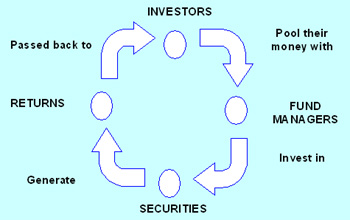
  • Your investment is pooled along with others’ investments.
  • Benefits derived as those of an institutional investor.
  • Risk diversification - investing in a pool of funds comprising of 50-60 stocks from various sectors.

Net Asset Value?

Income on Investments: (e.g. Dividend/Appreciation/Profit)
Less: Expenses: (e.g. AMC Fees, Custodian Fees, Registrar’s Fees) = Net Asset Value (NAV)

  • Financial planning.
  • Risk control.
  • Diversification.
  • Investment management capabilities.
  • Convenience.


Open-ended Schemes

  • Always open for investmen.
  • Always open for refund.
  • No fixed Corpus.

Close-ended Schemes

  • Open for a fixed period.
  • Traded through secondary markets.
  • Fixed Corpus.
  • Invest regularly and periodically instead of Lump sum / 1 time investment.
  • For e.g. If you have Rs. 60,000 to invest - you can either do a one time investment or alternatively you can spread the investment amount over a period of time say Rs. 5,000 every month for 12 months or Rs. 10,000 every month for 6 months
   
Who wins in the Long run ?


  • Those who plan in advance.
  • Those who start early.
  • Those who invest regularly.

Inflation - The silent killer

Equities can help you maintain your living standard

 
Conclusion
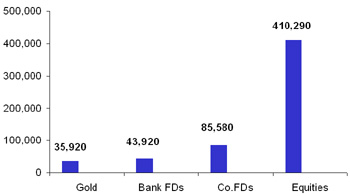
  • Diversified equity funds yield better returns than other investment instruments such as RBI Bonds, fixed deposits etc over the long term.
  • Valuations are still attractive at prevailing prices relative to historical valuations and other emerging market.
  • Infrastructure growth & economic reforms will likely boost corporate earnings and positively influence market cap.
 
For application forms and more details, please do contact us.